When someone’s heart suddenly stops, every second counts. Performing high-quality CPR can greatly improve a patient’s chances of survival. Among all the factors that matter, the Chest Compression Fraction (CCF) is often overlooked—but it’s extremely important. So, what exactly is chest compression fraction? Let’s take a closer look!
.png?w=1920&h=1080)
What is Chest Compression Fraction?
Chest Compression Fraction (CCF) is the percentage of time during a resuscitation effort that chest compressions are actually being performed.
The formula is:
CCF = Time spent on chest compressions ÷ Total resuscitation time
Example:
· If a resuscitation lasts 10 minutes and compressions are given for 6 minutes, the CCF is 0.6 (or 60%).
· Guidelines recommend that high-quality CPR should aim for a CCF of 80% or higher.
In other words, the longer the compressions continue without interruption, the higher the CCF will be, and the greater the patient’s chance of survival.
Why is CCF So Critical for Resuscitation Outcomes?
Chest compressions are the main way to maintain blood flow to vital organs. When compressions stop, blood pressure drops rapidly within seconds. After compressions resume, it takes some time to restore effective blood flow.
This means that:
· Lower CCF results in less time of effective compressions, which reduces perfusion efficiency.
· Higher CCF means more continuous compressions, which significantly improves survival chances.
CCF is the most direct and measurable way to evaluate the continuity of CPR. It is also a key parameter for assessing how efficiently a team works together during resuscitation.
Key Factors That Directly Affect CCF
During cardiac arrest resuscitation, the effectiveness of chest compressions depends not only on the quality of each compression but also on various operational and process factors. These factors can directly cause interruptions, which reduce the Chest Compression Fraction (CCF).
1. Interruptions caused by ventilation timing or technique
If ventilation pauses are too long, ventilations are excessive, or compressions and ventilations are not synchronized, compressions are frequently interrupted. This significantly lowers the continuity of compressions.
2. Airway management procedures
Procedures such as intubation, placing a supraglottic airway, or adjusting airway devices can cause prolonged pauses if the team lacks coordination or experience.
3. Interruptions during AED or defibrillation
Pauses occur while the AED analyzes the heart rhythm, prepares for a shock, or waits before and after delivering a shock. Modern guidelines emphasize that all defibrillation-related pauses should be kept as short as possible.
4. Inefficient team handoffs or poor preparation
When the person performing compressions becomes fatigued, a replacement is needed. If the handoff is unprepared or poorly coordinated, additional pauses occur, directly reducing CCF.
5. Disorganized team workflow or inadequate equipment preparation
During resuscitation, interruptions can occur if the team needs to adjust monitors, retrieve suction devices, reposition the patient, or search for tools, pads, or tubing.
In summary: The main factor affecting CCF is not how well compressions are performed, but whether they can be delivered without interruption. Low CCF is often not a technical issue but a problem of workflow and team coordination.
How to Improve Chest Compression Fraction (Practical Tips)
1. Assign roles and responsibilities in advance
The team should have a clear plan before starting resuscitation. The leader, compressor, ventilator, and AED operator should all know their roles.
2. Minimize unnecessary ventilation interruptions
Maintain the recommended 30:2 compression-to-ventilation ratio when using basic airway management.
When using an advanced airway, make sure ventilations are not too frequent.
3. Optimize AED and defibrillation workflow
Keep pauses as short as possible during AED rhythm analysis.
Immediately resume compressions after a shock without waiting for rhythm interpretation.
4. Intubation strategies
Do not rush intubation. Whenever possible, perform intubation while compressions continue. Experienced operators can limit pauses to only a few seconds.
5. Smooth handoff between compressors
It is recommended to switch compressors every two minutes. Only switch when the next person is ready to avoid any gap in compressions.
6. Improve through training and practice
Systematic training and practice are crucial for increasing CCF. Simulation and real-time feedback help learners understand the importance of continuous compressions and develop muscle memory.
a. Using feedback devices or training models
- Feedback devices and training models help learners maintain correct compression rate, depth, and recoil.
- CCF data recording allows instructors to analyze interruptions and guide improvements.
- Training Model Recommend: The SimCoach CPR chest compression training model with sound system provides immediate audio feedback on compression rhythm and force, simulating real-life scenarios and helping learners practice continuous, high-quality compressions.
b. Training methods and practical exercises
- Practice smooth team handoffs every two minutes without stopping compressions.
- Simulate AED and defibrillation scenarios to minimize pauses during analysis and shocks.
- Practice airway management while compressions continue to safely perform intubation or airway placement.
Through systematic training and repeated practice, learners can improve compression efficiency and maintain higher CCF in real CPR, ultimately increasing patient survival chances.
Target CCF and Guideline Recommendations
Whether in pre-hospital or in-hospital resuscitation, major guidelines agree on one key point: the higher the Chest Compression Fraction (CCF), the better. In general, a CCF of 0.8 or higher, which is 80 percent, is recommended. This means that during a resuscitation effort, chest compressions should be maintained for at least 80 percent of the total time without interruption.
Different Scenarios
1. Two-person CPR
When two people work together, role handoffs are smoother, making it easier to maintain a high CCF. By assigning roles in advance for the compressor, ventilator, and AED operator, interruptions can be significantly reduced.
2. Advanced teams (ACLS settings)
Professional teams have advantages such as extensive airway management experience, well-practiced defibrillation procedures, and clear communication. These factors make it easier to achieve a CCF of 0.85 or higher. However, excessive interventions that cause interruptions must still be avoided.
3. Pediatric or infant CPR
Although children have different anatomy, the principle of CCF remains the same. Fewer interruptions lead to more stable perfusion and higher chances of successful resuscitation. In pediatric CPR, attention should be paid to minimizing pauses during ventilation.
Key Point: A high CCF does not replace high-quality compressions. Both are essential and complementary. According to guidelines, high-quality CPR requires:
- Proper compression depth, about 5 to 6 centimeters for adults
- Compression rate of 100 to 120 per minute
- Full chest recoil after each compression
- Minimizing interruptions
High CCF combined with high-quality compressions equals truly effective CPR.
Common Misconceptions and Clarifications
Misconception 1: As long as compressions continue, it is enough
The truth is that while continuous compressions are important, you cannot sacrifice compression depth, rate, or full chest recoil. High CCF does not mean rough or careless compressions.
Misconception 2: Long pauses are necessary during defibrillation
Modern guidelines emphasize proper preparation and timing.
- Pads should be applied in advance.
- Shocks should be delivered immediately after AED analysis.
- Compressions should resume immediately after the shock.
In practice, the pause for defibrillation can be shortened to around five seconds, without any need for long delays.
Misconception 3: Compressions must stop completely for intubation
This traditional view is outdated. Experienced teams can perform airway placement while compressions continue, requiring only a very brief pause of two to three seconds if needed.
Misconception 4: More team members are always better
Having more people does not always improve efficiency. If the team lacks clear leadership, has overlapping roles, or interferes with each other’s actions, it can cause more interruptions. The key is clear role assignment, not simply having more personnel.
Summary
Chest Compression Fraction (CCF) is the most important indicator of CPR continuity. It directly affects organ perfusion and the patient’s chances of survival.
Key factors for improving CCF include minimizing unnecessary interruptions, optimizing team coordination and workflow, maintaining high-quality compression technique, and using feedback devices for systematic training. Through repeated practice and simulation exercises, learners can maintain higher compression continuity in real-life resuscitation, significantly increasing the success rate of CPR.
The SimCoach CPR compression training models include two basic versions designed for practicing continuous chest compressions. They help learners develop a steady compression rhythm and build muscle memory. The version with a sound feedback system provides immediate cues on compression rate and force, allowing learners to better understand and perform high-quality compressions during practice.
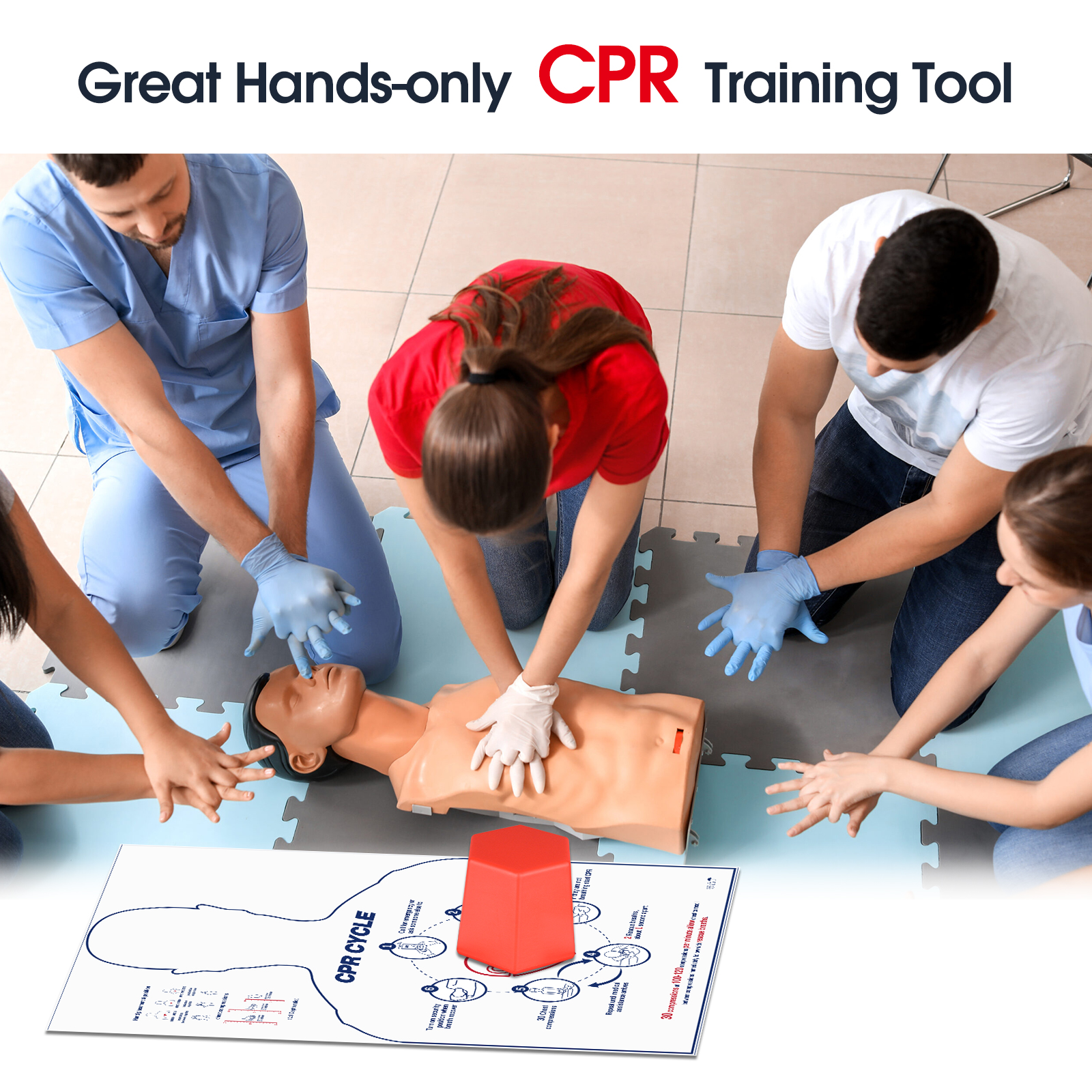
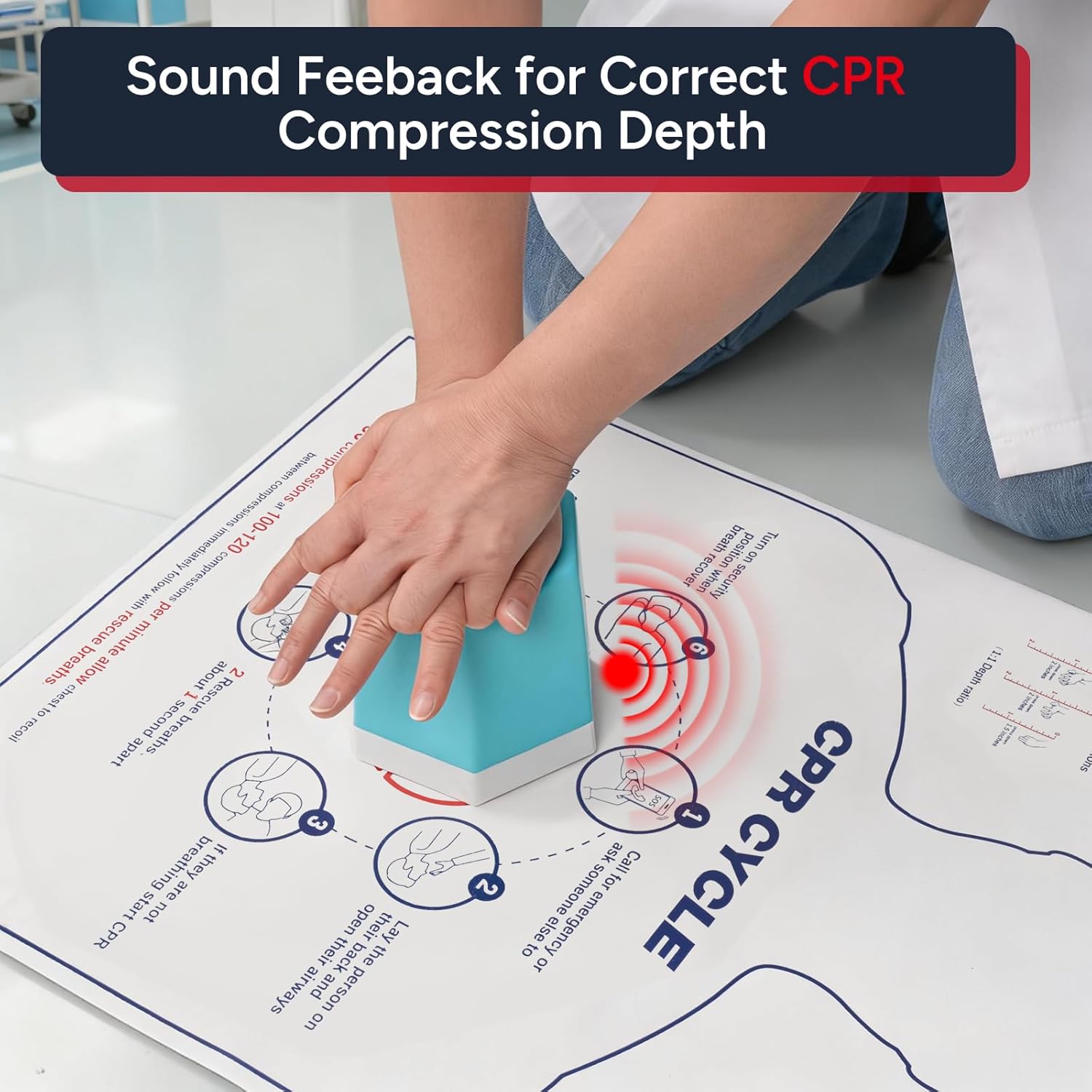
Although small in size, these cubes are carefully designed to simulate real chest resistance and feel, providing a training experience close to actual resuscitation. They are economical, easy to use, and highly effective for training. Suitable for nursing and medical students, emergency training institutions, hospital CPR courses, and community first aid education.